

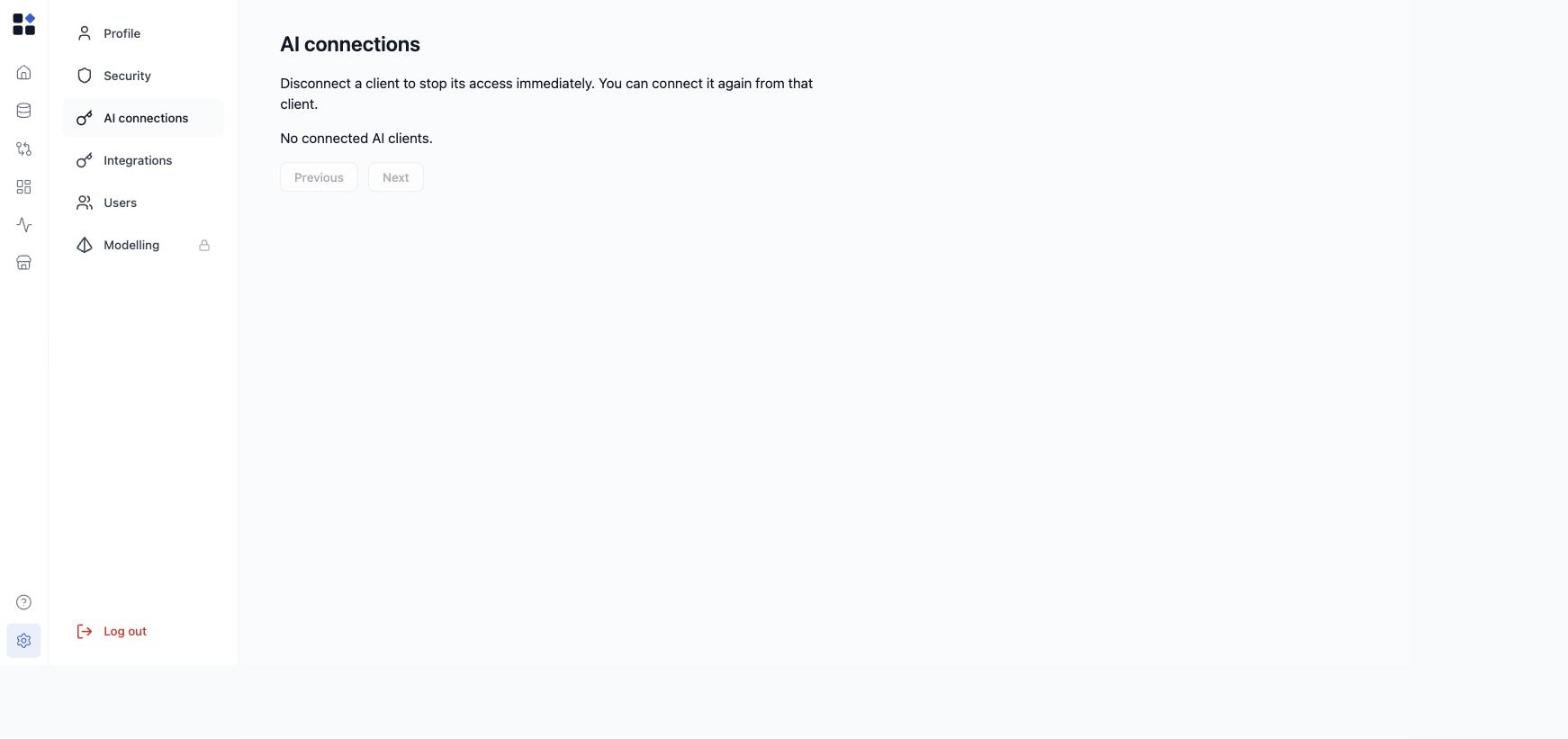
AI connections is rolled out per organization. If the tab is missing or the endpoint is not yet available to you, ask us to switch it on for your account and we will send you the endpoint to use.
What an AI client can do
The connection is read-only. A connected client can look at your data and reason about it, but it cannot change a price, run an agent, or write anything back. Five capabilities are exposed:
Two limits are worth knowing before you ask an assistant a question and wonder why the answer looks thin:
- Grids are per person, not per organization. A client connected to your account sees the grids you own. Your teammates’ grids stay private to them.
- Live formula columns are not readable. A client can read canonical and stored columns from a grid; formula columns that compute on the fly are not exposed. If you want an assistant to see a calculation, materialize it rather than leaving it as a live formula.
Connect a client
The connection starts in the AI client, not here. In broad terms:- Add Retailgrid as an MCP server in your client, using the endpoint we provide for your organization.
- The client sends you to Retailgrid to sign in, if you are not already signed in.
- Retailgrid shows you a consent screen naming the client that is asking for access. Read it, then approve or decline.
- On approval the client is connected, and it appears in the list on this page.
Disconnect a client
Find the client in the list and disconnect it. Access stops immediately: the client’s existing authorization is revoked rather than left to expire. If you want it back later, connect again from that client. Disconnecting is not destructive and does not affect your data. Disconnect when:- You are no longer using that assistant.
- You installed a client on a device you no longer have.
- You are not sure what a listed client is. Disconnect first and reconnect deliberately.
Good practice
- Review the list periodically. Treat it like any other list of things holding access to your data.
- Connect one client at a time and check the list afterwards, so every entry is one you recognize.
- Remember it is read-only. If someone tells you an AI client changed a price in Retailgrid, that did not happen over this connection.
- Prefer the API for integrations. This endpoint is built for interactive assistants. Scheduled syncs into an ERP or BI tool belong on the public API, which is stable, paginated for extraction, and scoped to an organization key rather than one person.